Red imported fire ants thrive in South Texas heat, nesting deep inside the caliche layers and heavy clays common to communities like Stone Oak, Helotes Creek, and Timberwood Park. During the dry summer months, colonies…
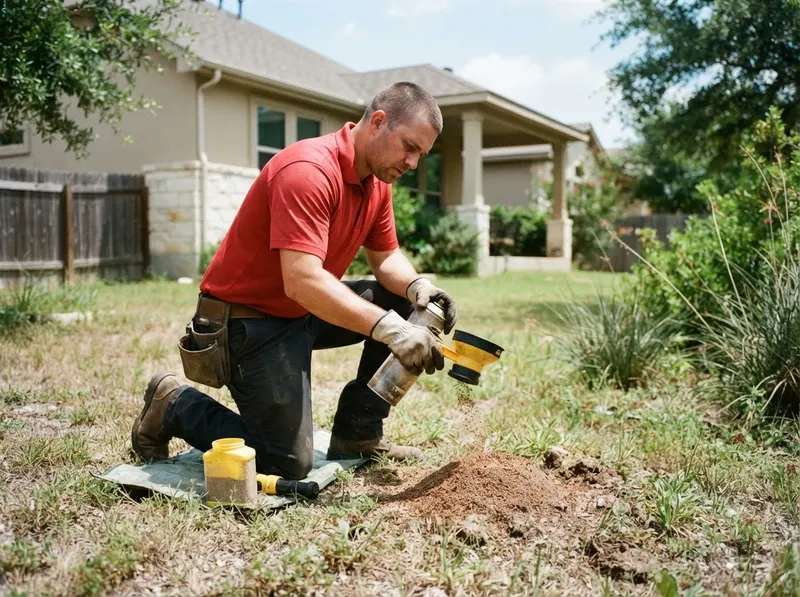
Red imported fire ants thrive in South Texas heat, nesting deep inside the caliche layers and heavy clays common to communities like Stone Oak, Helotes Creek, and Timberwood Park. During the dry summer months, colonies dig several feet below the surface to reach soil moisture, emerging after localized rainstorms to build visible mounds across lawns, play structures, and patio perimeters. Surface retail sprays kill only the visible surface foragers, which prompts the colony to bud into multiple satellite queens. Professional broadcast treatment deposits weather-tolerant granular baits across the turf that worker ants carry directly to the queen. This stops reproduction at the source without leaving synthetic chemical odors around your home.
Properties bordering natural terrain near the Dominion, Culebra Park, or greenways near McAllister Park face constant reinvasion pressure from neighboring fields. A spot-treatment approach rarely works because fire ants simply relocate 10 feet away. If your yard has 1 or 2 small mounds in an isolated bed, manual drenching suffices. If mounds are distributed across an open lawn or near domestic pets and play areas, a broadcast treatment paired with an insect growth regulator is necessary. The operational trade-off is treatment speed versus longevity: direct liquid drenching provides an immediate localized knockdown within 4 hours, whereas whole-yard broadcast baits take 7 to 14 days to fully collapse subterranean nests but prevent mound re-emergence for up to 8 to 12 months.
1. Initial turf inspection: A technician walks the property perimeter, marking active mounds, irrigation hazards, and pet zones.
2. Broadcast baiting: A calibrated broadcast spreader distributes an insect growth regulator bait across the entire yard footprint at labeled rates.
3. Targeted mound saturation: Visible high-traffic mounds near foundations, walkways, or turf areas receive direct contact applications.
4. Post-treatment evaluation: Moisture guidelines and re-entry timelines (typically once granules settle and treated mounds dry, roughly 1 to 2 hours) are reviewed on-site.
Every job gets a firm, written price after a free on-site visit.
Tell us about your fire ant yard treatment job in San Antonio and we'll send a clear, written quote, usually the same day.
 Red Barn Pest Control